Sunday, 21 June 2015

Comparatives and superlatives.

Comparative adjectives video.


Superlative Adjectives video.


Comparative adjectives 1. Click here.

Comparative adjectives 2. Click here.

Superlative adjectives 1. Click here.

Superlative adjectives 2. Click here.

More exercises. Click here.

Let's practice listening.
Comparatives and superlatives.


Time to play.

Games.


PAST CONTINUOUS


How do we use the Past Continuous Tense?

The Past Continuous tense expresses action at a particular moment in the past. The action started before that moment but has not finished at that moment. For example, yesterday I watched a film on TV. The film started at 7pm and finished at 9pm.
At 8pm yesterday, I was watching TV.
past present future

8pm
At 8pm, I was in the middle of watching TV.

When we use the Past Continuous tense, our listener usually knows or understands what time we are talking about. Look at these examples:
  • I was working at 10pm last night.
  • They were not playing football at 9am this morning.
  • What were you doing at 10pm last night?
  • What were you doing when he arrived?
  • She was cooking when I telephoned her.
  • We were having dinner when it started to rain.
  • Ram went home early because it was snowing.
Note that some verbs cannot be used in continuous/progressive tenses.
We often use the Past Continuous tense to "set the scene" in stories. We use it to describe the background situation at the moment when the action begins. Often, the story starts with the Past Continuous tense and then moves into the Past Simple tense. Here is an example:
"James Bond was driving through town. It was raining. The wind was blowing hard. Nobody was walking in the streets. Suddenly, Bond saw the killer in a telephone box..."

Past Continuous + Past Simple

We often use the Past Continuous tense with the Past Simple tense. We use the Past Continuous to express a long action. And we use the Past Simple to express a short action that happens in the middle of the long action. We can join the two ideas with when or while.
In the following example, we have two actions:
  1. long action (watching TV), expressed with Past Continuous
  2. short action (telephoned), expressed with Past Simple
past present future
long action:
I was watching TV from 7pm to 9pm.

8pm

short action:
You phoned at 8pm.
We can join these two actions with when:
  • I was watching TV when you telephoned.
Notice that "when you telephoned" is also a way of defining the time (8pm).
We use:
  • when + short action (Past Simple)
  • while + long action (Past Continuous)
There are four basic combinations:
I was walking past the car when it exploded.
When the car exploded I was walking past it.
The car exploded while I was walking past it.
While I was walking past the car it exploded.
Notice that the long action and short action are relative.
  • "Watching TV" took two hours. "Telephoned" took a few seconds.
  • "Walking past the car" took a few seconds. "Exploded" took milliseconds.
 Information taken from: https://www.englishclub.com/grammar/verb-tenses_past-continuous_u.htm

Past continuous exercise 1. Click here.
Past continuous. Exercise 2. Click here.
Past continuous. Exercise 3. Click here.
Past continuous. Exercise 4. Click hete.
Past continuous. Exercise 5. Click here.


 Watch the videos if you think you need extra listening practice.


Sunday, 26 April 2015

WH- QUESTIONS.


WH- QUESTIONS.


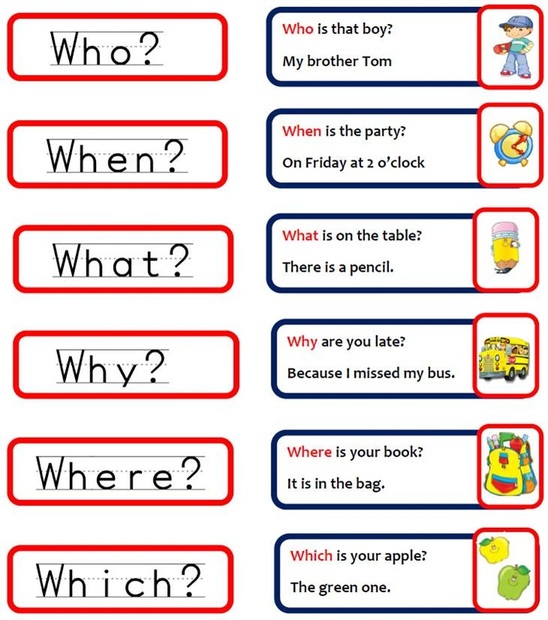
Question words are also called wh questions because they include the letters 'W' and 'H'.
Question words Meaning Examples
who person Who's that? That's Nancy.
where place Where do you live? In Boston
why reason Why do you sleep early? Because I've got to get up early
when time When do you go to work? At 7:00
how manner How do you go? By car
what object, idea or action What do you do? I am an engineer
which choice Which one do you prefer? The red one.
whose possession Whose is this book? It's Alan's.
whom object of the verb Whom did you meet? I met the manager.
what kind description What kind of music do you like? I like quiet songs
what time time What time did you come home?
how many quantity (countable) How many students are there? There are twenty.
how much amount, price (uncountable) How much time have we got? Ten minutes
how long duration, length How long did you stay in that hotel? For two weeks.
how often frequency How often do you go to the gym? Twice a week.
how far distance How far is your school? It's one mile far.
how old age How old are you? I'm 16.
how come reason How come I didn't see you at the party?

http://www.myenglishpages.com/site_php_files/grammar-lesson-wh-questions.php


Wh questions. Exercises. Click here.

Wh questions. Exercises 2. Click here.

Wh- questions. Exercise 3. Click here. 


FREQUENCY ADVERBS.


Frequency adverbs revision I know you are experts on this.............but it would be worthy if you try doing the exercises.


FREQUENCY ADVERBS EXERCISES. CLICK HERE.

I found this video when I was looking for some exercises and I liked it, I hope you like it too.


Monday, 6 April 2015

HOW MUCH, HOW MANY, A FEW, A LITTLE.


1.- When do we use much and when many? 
  • much: uncountable nouns (milk, water, money, time etc.)
  • many: countable nouns (bottles of milk, jars of marmalade, dollars, minutes, etc.)

    Examples:

  • How much money have you got?
  • How many dollars have you got?

In informal English these questions are often answered with a lot of, lots of. There is no much difference between the two phrases.

2.- When do we use a little and when a few?
  •  a little: non countable nouns (milk, marmalade, money, time etc.) 
  • a few: countable nouns (bottles of milk, jars of marmalade, dollars, minutes etc.)
Examples:
  • He has a little money left.
  • He has a few dollars left.

3.- When do we use some and when any?

We use some and any for an amount which is not known e.g. Have you got any crisps?

Use of some and any.
  • some: affirmative statements, offers, requests and in questions when you expect the answer ›yes‹
  • any: negative statements, questions
Have you got any bananas? No, we haven't got any. But we've got some oranges.

Exceptions:

I would like to buy fruit at a market. I see the man has wonderful apples so I can ask him:
  • Can I have some of these apples?
If I do not see apples or if I am not sure whether there are apples at all I use any in this question.
  • Have you got any apples?
 http://www.englisch-hilfen.de/en/grammar/much_many.htm

How much/how many exercises. Click here.

How much / how many exercises 2. Click here.

Some or any exercises 3. Click here.

Some and any exercises 4. Click here.

Some and any exercises 5. Click here.

This is a very usefful video, especially for those who want to learn more about this topic.


Saturday, 14 March 2015

SIMPLE PAST OTHER VERBS.


REGULAR AND IRREGULAR VERBS

Regular verbs

Those verbs that form their past participle with ‘d’ or ‘ed’ are regular verbs. These verbs do not undergo substantial changes while changing forms between tenses.
  1. If the verb ends with a vowel, only ‘d’ is added. For example:
PRESENT TENSE PAST TENSE
Share Shared
Scare Scared
Dare Dared
  1. If the verb ends with a consonant, ‘ed’ is added. For example:
PRESENT TENSE PAST TENSE
Want Wanted
Shout Shouted
Kill Killed

Irregular verbs

Those verbs that undergo substantial changes when changing forms between tenses are irregular verbs. The changed forms of these verbs are often unrecognisably different from the originals. For example:
PRESENT TENSE PAST TENSE
Go Went
Run Ran
Think Thought

There is no way to tell what form an irregular verb is going to take in a changed tense; the only option for an English speaker is to commit the changes to memory. With practice, it will become a matter of habit.


 Simple past Reading. Click here.


Now it is time that you start working on this topic, so...........


Simple past exercise. Click here.
Simple past crossword. Click here.
Simple past exercise 2. Click here.
Simple past. Memory game. Clcik here.
Simple past fill in the blanks exercise. Click here.